Cork, silicone, ceramic, paper, and leather are five popular options, but they serve different purposes. An absorbent paper coaster may work well for a busy beer festival, while a leather coaster could be a better fit for a premium corporate gift. A silicone coaster may be practical for repeated everyday use, whereas ceramic is often selected for decorative retail collections.
This guide compares five custom coaster materials from a B2B purchasing perspective, covering their advantages, limitations, customization methods, and suitable applications.
Quick Answer: What Is the Best Material for Custom Coasters?
There is no single best coaster material for every application. The best choice depends on where the coaster will be used, how long it needs to last, the desired branding effect, and the total procurement budget.
- Best for natural aesthetics: Cork coasters.
- Best for flexible, water-resistant everyday accessories: Silicone coasters.
- Best for decorative full-color designs: Ceramic coasters.
- Best for absorbent bar and event coasters: Paper coasters.
- Best for premium corporate gifts: Leather and selected PU leather coasters.
These recommendations are starting points rather than universal performance rankings. Material construction, surface treatments, printing methods, and actual product testing can change the result.
Custom Coaster Materials Comparison Chart
Use the following comparison to shortlist materials before requesting samples or wholesale quotations.
| Material | Key Strength | Main Limitation | Common Branding | Recommended Application |
|---|---|---|---|---|
| Cork | Lightweight, natural appearance, thermal insulation | Textured surface; moisture performance depends on construction | Screen printing, UV printing | Cafés, natural-style gifts, retail sets |
| Silicone | Flexible, water-resistant, customizable colors | Not absorbent; molded designs may require tooling | Molded logos, printing, recessed and raised effects | Promotional gifts, branded merchandise, everyday use |
| Ceramic | Rigid decorative surface, detailed artwork options | Fragile during handling and shipping | Surface-specific full-color printing | Souvenirs, homeware, decorative gifts |
| Paper | Absorbent grades, lightweight, high-volume distribution | Limited useful life compared with many reusable materials | Spot-color and full-color printing | Bars, breweries, festivals, beverage promotions |
| Leather / PU Leather | Premium appearance and tactile finish | Requires suitable surface care; properties vary by material | Debossing, foil stamping, screen printing, UV printing | Executive gifts, hospitality, branded retail sets |
Note: The table compares typical material characteristics. Exact performance and available printing methods depend on the selected product construction.
1. Cork Coasters: Best for Natural Texture and Understated Branding
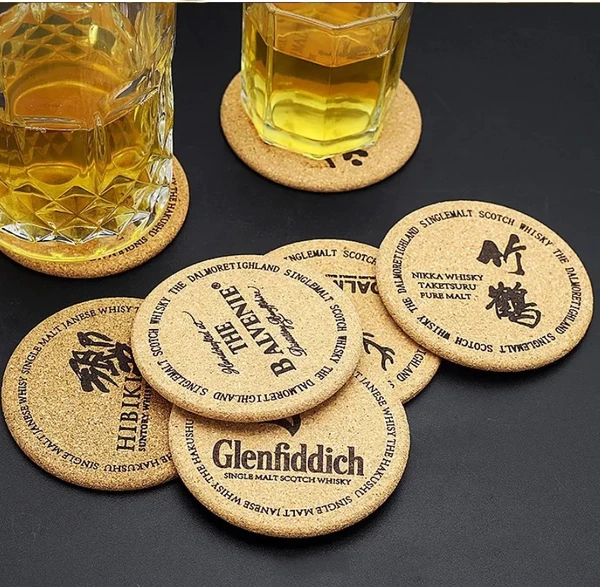
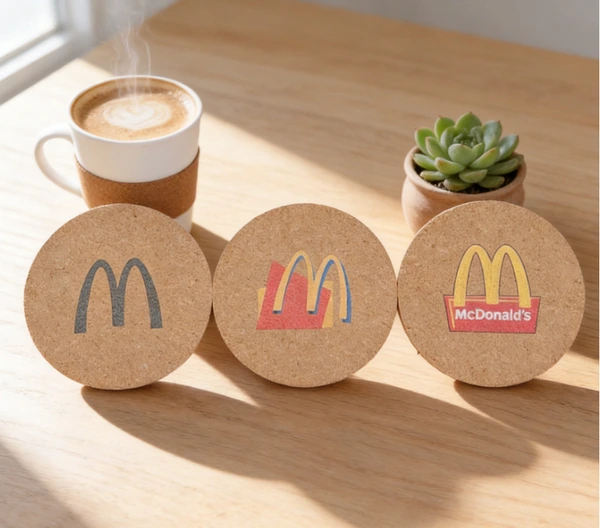
Cork is a distinctive material for companies looking for a natural, warm, and understated design. Its cellular structure makes it relatively lightweight and provides useful insulating properties.
It is commonly selected for branded café accessories, promotional gifts, office products, and souvenir collections.
Advantages of Custom Cork Coasters
- Natural texture that complements minimalist and earth-toned designs.
- Lightweight construction for promotional distribution.
- Useful cushioning and thermal insulation for everyday drinkware.
- Available in round, square, rectangular, and selected custom shapes.
- Suitable for screen-printed logos and selected UV-printed designs.
What Are the Limitations?
Natural cork has a textured surface and variable base color. Extremely small text, intricate lines, or demanding color specifications may not reproduce as sharply as they would on a smooth white material.
Another common misconception is that every cork coaster is completely waterproof. Although cork has natural moisture-resistant properties, the performance of a finished coaster also depends on its binders, surface treatments, and printing.
Likewise, cork’s insulating properties do not automatically establish a specific maximum safe temperature for a finished product.
Best Applications for Cork Coasters
Cork is particularly suitable for cafés, office desk accessories, organic-looking branded merchandise, hospitality gifts, and nature-inspired retail collections.
For custom shapes, screen printing, UV printing, and matching placemats, explore our custom cork coasters and placemats.
2. Silicone Coasters: Best for Flexible and Colorful Promotional Products
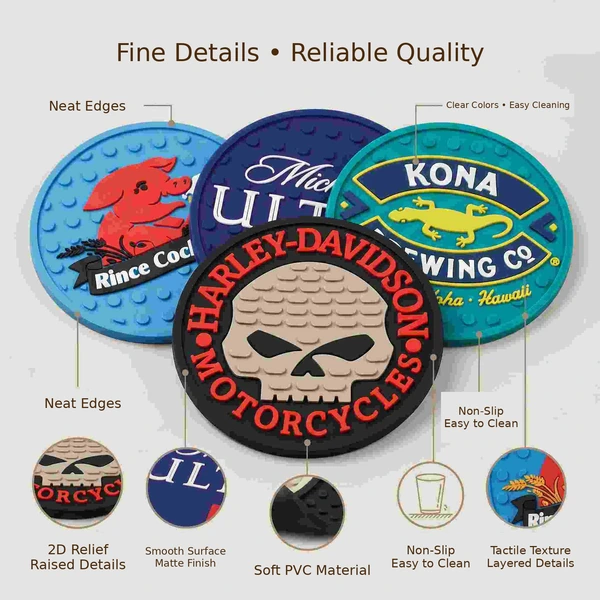
Silicone coasters offer a different design approach. Instead of highlighting a natural material texture, they allow buyers to focus on color, flexibility, molded detail, and distinctive product shapes.
They are useful for brands seeking reusable promotional accessories, sports merchandise, event giveaways, and custom-shaped drink coasters.
Advantages of Silicone Coasters
- Flexible construction that is less vulnerable to breakage than rigid ceramic.
- Water-resistant material that can be easier to wipe clean.
- Custom color options, subject to production requirements.
- Raised or recessed logo effects for tactile branding.
- Custom shapes for brand mascots, logos, and promotional themes.
Silicone Logo Customization
Depending on the product design and manufacturing process, silicone coasters may feature recessed logos, raised details, color-filled elements, or printed graphics.
For molded designs, tooling requirements should be confirmed early. The depth of details, minimum line width, color separation, and mold structure can affect both feasibility and cost.
What Are the Limitations?
Silicone is generally non-absorbent. It does not perform the same moisture-absorbing function as a dedicated absorbent paper coaster.
Condensation can remain on the surface unless the design incorporates channels or other features that manage liquid. Very thin or poorly supported shapes may also be less stable for certain drinkware.
Material grade and product construction should be checked for heat-sensitive applications rather than assuming every silicone product has the same temperature rating.
Best Applications for Silicone Coasters
Choose silicone for promotional merchandise, custom-shaped gifts, sports and outdoor-themed branding, reusable desk accessories, and designs where bright colors or tactile logos matter.
See our custom silicone coasters for available design and customization options.
3. Ceramic Coasters: Best for Decorative Graphics and Retail Gift Collections
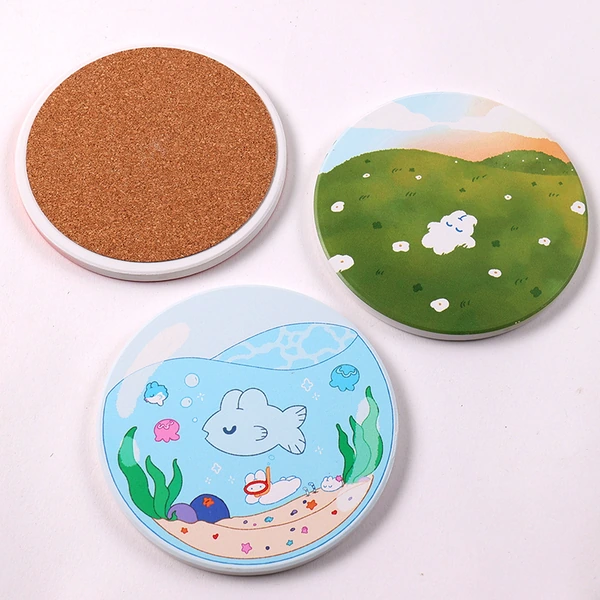
Ceramic coasters are commonly used where visual presentation is a priority. Their rigid structure and printable decorative surfaces can work well for illustrated artwork, photography-inspired designs, souvenirs, and premium-looking gift sets.
However, not all ceramic coasters have the same surface construction or absorbency.
Glazed vs. Absorbent Ceramic Coasters
Glazed ceramic coasters generally have a relatively smooth, less absorbent decorative surface. Condensation may remain on the coaster rather than being absorbed.
Absorbent ceramic or porous stone-style coasters are designed to take in moisture under suitable conditions. Performance depends on the actual material, porosity, coating, and printing method.
These two product types should not be described interchangeably in a wholesale quotation.
Advantages of Custom Ceramic Coasters
- Attractive rigid construction for decorative applications.
- Suitable for many full-color artwork concepts.
- Popular for tourism merchandise and illustrated collections.
- Can be paired with protective backing where applicable.
- Well suited to coordinated multi-design gift sets.
What Are the Limitations?
Ceramic products require more careful handling and protective packaging than flexible silicone or lightweight paper coasters.
For international wholesale orders, buyers should consider individual product protection, carton organization, total shipment weight, and possible breakage during transport.
Print durability, liquid absorption, and cleaning requirements must be confirmed for the specific finished product.
Best Applications for Ceramic Coasters
Ceramic is suitable for tourist gift shops, illustrated retail collections, hotels, homeware brands, corporate gift sets, and souvenir merchandise featuring detailed designs.
Explore our custom ceramic coasters for artwork and product options.
4. Paper Coasters: Best for Bars, Breweries and High-Volume Events

For many hospitality and promotional applications, absorbent paper coasters are a practical choice.
Often called beer mats or pulpboard coasters, these products are commonly used beneath cold drinks in bars, breweries, restaurants, and festivals.
Their primary advantage is not long-term durability. Instead, it is their suitability for beverage service, printed promotions, and high-volume distribution.
Advantages of Absorbent Paper Coasters
- Absorbent constructions can help manage drink condensation.
- Lightweight and convenient for large promotional quantities.
- Suitable for colorful printed advertisements and brand graphics.
- Available in round, square, and selected custom shapes.
- Useful for seasonal beverage campaigns and changing promotional artwork.
Paper Coaster Thickness Matters
Paper coasters are manufactured in different board grades and thicknesses. A 2 mm absorbent pulpboard coaster, for example, serves a different purpose from an ordinary thin printed paper card.
For beverage service, buyers should specify an absorbent coaster-grade material rather than requesting generic printed cardboard.
Thickness, board density, ink coverage, and coatings can all influence liquid absorption and product behavior.
What Are the Limitations?
Paper coasters normally have a shorter useful life than materials such as silicone, ceramic, or leather.
Extended liquid exposure may lead to staining, softening, curling, or changes in surface appearance, depending on the construction.
If a customer wants a reusable retail coaster intended to last for a long period, paper may not be the first material to consider.
Best Applications for Paper Coasters
Paper coasters work particularly well for breweries, beer festivals, bars, beverage distributors, hotel events, restaurant promotions, and marketing campaigns requiring large quantities.
Learn more about our custom absorbent paper coasters, including printed designs and bulk-order applications.
5. Leather Coasters: Best for Premium Corporate Gifts

Leather coasters are an attractive option when the perceived value of the gift, its texture, and its presentation matter more than producing the lowest possible unit cost.
They are often used in corporate gift programs, executive office accessories, hospitality settings, branded retail merchandise, and personalized gift sets.
Both genuine leather and synthetic leather materials may be considered, but they should be quoted and described accurately.
Genuine Leather vs. PU Leather Coasters
Genuine leather offers natural material characteristics and a distinctive surface appearance. Grain, texture, color variation, and finish depend on the selected leather.
PU leather is a synthetic alternative available in different textures, colors, and constructions. It can be useful for projects requiring a consistent manufactured surface or a particular budget.
Neither material should be automatically described as completely waterproof or maintenance-free. Surface treatments and actual performance vary.
Popular Customization Methods
- Debossing: A recessed logo creates an understated tactile effect.
- Foil stamping: Gold, silver, or selected metallic effects can create decorative branding.
- Screen printing: Suitable for certain simple graphics on compatible surfaces.
- UV printing: Can support selected multicolor artwork when the material and finish are suitable.
- Custom shapes: Round, square, rectangular, and other shapes can be reviewed for production.
What Are the Limitations?
Leather and PU leather surfaces can respond differently to moisture, heat, cleaning, and repeated use.
Small embossed details may lose clarity on coarse or heavily textured surfaces. Fine foil-stamped artwork may also require adjustments to achieve consistent results.
For premium orders, buyers should evaluate edge finishing, stitching where applicable, material thickness, logo placement, and packaging quality.
Best Applications for Leather Coasters
Leather-style coasters are suitable for executive gifts, real estate client gifts, hotel guest accessories, luxury-inspired merchandise, office collections, and personalized corporate gift sets.
Review our custom leather coasters for material, logo, and shape options.
Cork vs. Silicone Coasters: Which Is Better?
This is one of the most useful comparisons for buyers planning reusable promotional drink coasters.
Choose cork when natural texture, relatively low weight, and a simple printed brand identity are the priorities.
Choose silicone when flexibility, custom material colors, molded branding, and easier surface wiping are more important.
Neither is automatically superior for all beverages or surfaces.
| Decision Factor | Cork | Silicone |
|---|---|---|
| Appearance | Natural, organic texture | Smooth or molded, colorful |
| Flexibility | Varies by thickness and construction | Generally flexible |
| Surface Water Resistance | Depends on finish and composition | Generally water-resistant and non-absorbent |
| Branding | Screen or UV printing | Molded effects and selected printing |
| Best Fit | Cafés and natural-style merchandise | Colorful branded gifts and everyday accessories |
Paper vs. Ceramic Coasters: Which Is Better for Restaurants and Bars?
For busy beverage service, an absorbent paper coaster is often a practical choice. It can be used for promotional messages, special drink campaigns, and high-turnover table service.
Ceramic coasters serve a different role. They are more appropriate when businesses want reusable decorative accessories, coordinated interior styling, or branded retail merchandise.
However, buyers should not assume every ceramic coaster absorbs condensation. A smooth glazed ceramic coaster may allow water to remain on the surface, while certain porous ceramic constructions are specifically designed for absorption.
For restaurants, a useful procurement question is: Will the coaster be used repeatedly as a durable table accessory, or replaced regularly during beverage service?
The answer often determines whether paper or ceramic should be considered first.
Which Coaster Material Is Best for Your Industry?
| Buyer / Industry | Recommended Materials | Reason |
|---|---|---|
| Coffee Shops | Cork, silicone, paper | Brand presentation, routine drink service, and material-specific moisture management |
| Bars and Breweries | Absorbent paper, cork | Promotional printing, condensation management, and beverage branding |
| Hotels and Resorts | Ceramic, leather, cork | Interior coordination and guest presentation |
| Corporate Gifts | Leather, cork, ceramic | Presentation, packaging, and useful branded accessories |
| Trade Shows and Events | Paper, silicone, cork | Distribution, budget, weight, and promotional visibility |
| Souvenir Shops | Ceramic, cork, leather | Illustration, distinctive material appearance, and gift sets |
| Sports Merchandise | Silicone, paper | Bold logos, team colors, and event promotions |
| Retail and E-commerce | All five, depending on collection | Differentiation through design, packaging, and customer expectations |
Which Custom Coaster Material Offers the Best Value for Bulk Orders?
The cheapest unit price does not necessarily produce the lowest total procurement cost.
For example, a paper coaster can be an economical option for a large event, but it may need more frequent replacement than a reusable coaster. Ceramic can provide attractive retail presentation, but protective packaging and shipping weight must be considered.
When comparing wholesale quotations, evaluate the following:
- Base material: Natural cork, molded silicone, ceramic construction, absorbent pulpboard, genuine leather, or PU leather.
- Size and thickness: Larger or thicker items generally require more material, but price changes are not always proportional.
- Printing method: Spot-color printing, full-color graphics, molding, debossing, or foil stamping may involve different setups.
- Quantity per design: Several designs in one order may require separate printing setup or tooling.
- Custom shape: Intricate outlines can affect tooling, material yield, and production feasibility.
- Packaging: Bulk packing, individually wrapped pieces, and custom retail boxes carry different costs.
- Freight: Carton size, gross weight, breakage protection, shipping method, and destination affect the landed cost.
- Quality requirements: Strict tolerances, complex artwork, special finishes, or additional testing may affect costs.
Practical example: A promotional distributor comparing 5,000 paper coasters with 5,000 ceramic coasters should not compare only the EXW unit prices. Ceramic may require heavier cartons and more protective packaging, while absorbent paper may be preferable if the products are intended for a single event.
For reusable retail gifts, the decision may be different because product lifespan, presentation, and retail positioning become more important.
Common Mistakes Buyers Make When Selecting Custom Coasters
Mistake 1: Confusing Water Resistance with Water Absorption
Water-resistant materials do not necessarily absorb condensation.
A silicone coaster may be easy to wipe clean but still leave condensation on its surface. An absorbent paper coaster is designed for a different function.
Always clarify whether you need liquid absorption, resistance to water penetration, or easy surface cleaning.
Mistake 2: Assuming All Coasters Are Safe for Extremely Hot Cookware
Ordinary drink coasters are not automatically suitable as trivets for hot pans or oven dishes.
Even when the base material provides heat insulation, adhesives, coatings, printing inks, and backing materials can have different temperature limits.
For high-temperature applications, ask for specifications or relevant testing of the finished product.
Mistake 3: Choosing a Printing Method Before Checking the Material
Fine logos may reproduce differently on smooth ceramic, textured cork, flexible silicone, and genuine leather.
Some designs may require a different printing method, thicker lines, modified artwork, or a change in material.
Review the artwork and proposed production process together before approving the order.
Mistake 4: Ignoring Thickness and Edge Finishing
Two coasters made from the same material can feel substantially different when their thicknesses, densities, cutting quality, and surface finishes differ.
Check for uneven edges, sharp corners, excessive flexibility, rough printing, or dimensional inconsistency.
Mistake 5: Comparing Prices Without Matching Specifications
A quotation for a single-color screen-printed coaster should not be treated as directly equivalent to a full-color design with an individual gift box.
Make sure all quotations use the same material, dimensions, thickness, logo specifications, quantities, packaging, and shipping terms.
Mistake 6: Using Environmental Claims Without Product Evidence
Natural and synthetic materials have different environmental considerations, but claims such as “100% biodegradable,” “recyclable,” or “certified sustainable” should be supported by evidence specific to the finished product and the relevant market.
For cork, for example, the natural raw material is renewable, but adhesives, inks, coatings, and other components must also be considered.
How to Evaluate Custom Coaster Samples Before Bulk Production
A physical sample can reveal important details that are difficult to judge from product photos alone.
For branded merchandise buyers, we recommend reviewing these points:
- Material identity: Confirm the exact material or construction being quoted.
- Dimensions: Measure the diameter or length and width, thickness, and shape.
- Artwork: Check logo positioning, line clarity, spelling, colors, and the overall printed appearance.
- Surface quality: Look for visible defects, uneven coatings, unwanted marks, and inconsistent texture.
- Edge finishing: Check cutting, molded edges, ceramic corners, or leather edges as applicable.
- Stability: Place representative drinkware on the coaster and observe its fit on the intended tabletop.
- Moisture behavior: Evaluate condensation or wiping requirements according to the intended use.
- Cleaning: Confirm the appropriate care instructions for the selected finish.
- Packaging: Check gift presentation, protection, product count, and carton suitability.
- Consistency: Agree on an approved reference sample and relevant acceptance criteria before bulk production.
For ceramic coasters, additional transport protection may be important. For absorbent paper, evaluate the specified grade and liquid absorption. For printed cork and leather, inspect the design carefully against the natural or textured surface.
How to Choose a Wholesale Custom Coaster Supplier in China
When sourcing custom promotional coasters from China, buyers should look beyond a catalog photograph or advertised unit price.
A suitable sourcing partner should be able to explain material differences, evaluate artwork, confirm customization requirements, coordinate samples, and provide a quotation based on complete specifications.
Useful questions to ask a potential supplier include:
- What is the exact material and thickness of the quoted coaster?
- Which logo printing or molding processes are suitable for my artwork?
- Are different designs allowed within one order?
- Will custom shapes require tooling or cutting charges?
- What sample options are available before production?
- Which product details will be checked during quality inspection?
- What packaging is recommended for my sales channel?
- Are the prices EXW, FOB, or based on another agreed Incoterm?
- Can the supplier coordinate other promotional items in the same project?
Lovecolour, based in Guangzhou, China, supports international buyers sourcing customized promotional products and branded merchandise. Our team can assist with artwork review, material selection, sourcing coordination, sampling arrangements, and order follow-up.
For brands, distributors, and corporate buyers comparing several coaster materials, a coordinated sourcing approach can simplify specification management and communication.
We can discuss individual coaster orders as well as multi-product promotional merchandise projects, depending on the required specifications.
Frequently Asked Questions About Custom Coaster Materials
What is the most durable material for custom coasters?
Durability depends on the type of wear involved. Silicone resists breakage from normal flexing and handling, while suitable ceramic constructions provide a rigid surface but are vulnerable to impact. Leather, cork, and paper have different wear characteristics. There is no universal durability winner without defining the product and testing conditions.
Which coaster material is best for cold drinks?
Absorbent paper and selected porous ceramic constructions are useful when managing condensation is the priority. Silicone, cork, and leather-style coasters may also be suitable for cold drinks, but they handle moisture differently. Buyers should distinguish absorption from water resistance.
Are cork or silicone coasters better for hot coffee?
Both can be considered for ordinary hot beverage applications when the finished product is suitable. Cork provides thermal insulation, while silicone properties depend on its formulation and grade. Confirm the finished coaster’s construction and intended temperature range rather than assuming a universal heat rating.
Which material is best for full-color printed coasters?
Suitable ceramic surfaces and selected paper products are useful for detailed multicolor designs. UV printing may also support complex artwork on compatible cork or leather-style surfaces. Print quality depends on material texture, coatings, ink systems, and artwork preparation.
Which coaster is best for a corporate gift?
Leather, cork, and ceramic are strong starting points for corporate gift programs. The choice depends on the recipient, brand positioning, budget, and packaging. Silicone can also be appropriate for more colorful or playful merchandise.
Are paper coasters cheaper than reusable coasters?
Absorbent paper coasters are often competitive for high-volume beverage promotions, but exact pricing depends on thickness, printing, order quantity, shape, and packaging. The lowest unit price should not be assumed without comparing matching specifications.
Can I order custom shapes in different materials?
Yes, custom shapes may be possible in cork, silicone, paper, and selected leather constructions. Ceramic shape options depend on the product design and manufacturing process. Very detailed outlines may require simplification or special tooling.
What information should I provide when requesting a wholesale coaster quotation?
Provide the selected material, dimensions, thickness, artwork, quantity per design, desired printing method, packaging, delivery location, and required schedule. If you are unsure which material is best, share your intended use and target budget so suitable options can be compared.
Final Recommendation: Match the Material to the Purpose
When choosing custom coaster materials, begin with the intended application rather than the product photograph.
For a bar promotion, absorbent paper may be the most practical choice. For a flexible and colorful brand giveaway, silicone may provide greater design freedom. Cork works well for natural aesthetics, ceramic for decorative collections, and leather for premium-looking corporate gifts.
Before placing a bulk order, confirm the material construction, printing method, dimensions, performance expectations, quantity, and packaging.
Making these decisions early helps reduce artwork revisions, sampling problems, misunderstandings, and avoidable purchasing costs.
Explore Custom Coaster Options from Lovecolour
- Custom Cork Coasters and Placemats – natural texture, screen printing, UV printing, and custom shapes.
- Custom Silicone Coasters – flexible materials, molded logos, and colorful branding.
- Custom Ceramic Coasters – decorative printing and retail gift designs.
- Custom Absorbent Paper Coasters – printed beer mats and beverage promotions.
- Custom Leather Coasters – debossing, foil stamping, printed logos, and premium gift sets.
Need Custom Coasters for Your Next Project?
Lovecolour helps promotional product distributors, hospitality buyers, event organizers, and corporate purchasing teams source custom branded merchandise.
Send us your artwork, estimated quantity, material preference, size, packaging requirements, and destination country. We can review the specifications and help you compare suitable coaster options.
Material Reference and Further Reading
For further information about natural cork’s cellular structure and material properties, see the Cork Institute of America’s overview of cork properties.
This buying guide provides general material and sourcing information. Actual product properties, customization capabilities, specifications, and quotations should be confirmed for each order.