Choosing a custom canopy tent is about more than selecting a size and adding your logo. The right tent depends on how often you use it, the event environment, the space you need, the branding requirements and your available budget.
A promotional pop up canopy for a weekend exhibition has different purchasing priorities from a reinforced commercial tent used repeatedly by an event rental company. An inflatable spider tent and a star shade tent also require different installation methods and site planning.
This guide explains how to compare six types of custom event tents, choose an appropriate size, evaluate materials and printing, and prepare an accurate wholesale quotation.
It is written for promotional products distributors, corporate marketing teams, event organizers, exhibition agencies, schools, sports organizations and international B2B buyers.
Quick Answer: Which Custom Canopy Tent Should You Choose?
For most temporary branded booths, a conventional pop up canopy is a practical starting point. Choose a commercial-grade reinforced frame when repeated handling and frame specifications are major purchasing considerations.
If you need more printed display space, consider a canopy with backwalls or half walls. For distinctive large-scale promotional installations, compare inflatable event tents and star shade structures instead.
| Tent Type | Primary Benefit | Best-Fit Applications | Critical Buying Check |
|---|---|---|---|
| Custom Pop Up Canopy | Conventional folding event booth | Trade shows, school events, promotions | Size, frame, roof and printing |
| Canopy with Sidewalls | More branded surfaces and defined space | Exhibitions, reception and vendor booths | Wall dimensions and attachment compatibility |
| Heavy Duty Commercial Canopy | Commercial-focused reinforced construction | Recurring events and rental operations | Frame specifications and operating limits |
| Food Vendor & Market Tent | Layout tailored to selling or serving | Farmers markets and food festivals | Service layout and local requirements |
| Inflatable Advertising Tent | Distinctive air-supported appearance | Sports sponsorships and brand activations | Air system, power and anchoring |
| Star Shade Tent | High-peak open-air visual impact | Festivals and large outdoor promotions | Anchoring footprint and usable clearance |
Important: This is a selection guide, not a universal performance ranking. The exact specifications and permitted applications depend on the selected model.
1. Understand the Main Types of Custom Event Tents
Custom Pop Up Canopy Tents: For Everyday Event Promotions
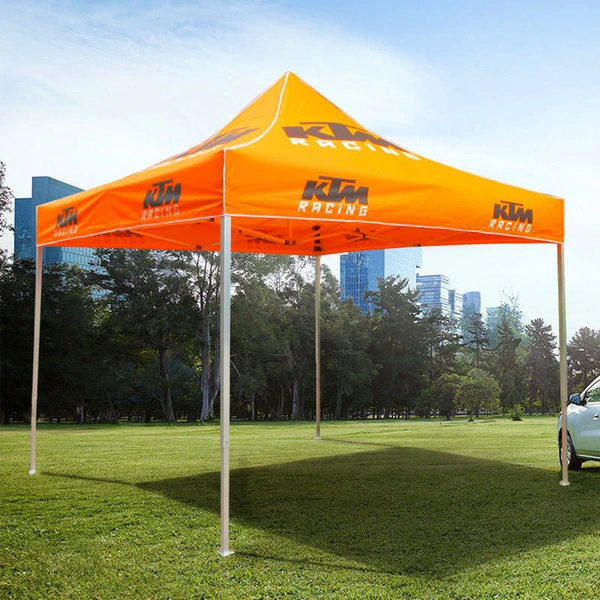
Pop up canopies use folding steel or aluminum frames with compatible fabric roofs. They are commonly used where businesses need a temporary promotional booth.
Branding may include a simple logo on a solid-color canopy or full-color graphics across suitable roof and valance panels.
Buyers can compare compact sizes with larger rectangular formats according to the allocated event footprint.
Choose this style when: You need a conventional folding booth for exhibitions, marketing promotions, university events or product displays.
Check before ordering: Exact frame size, folding structure, printing layout, packed dimensions and included accessories.
Printed Canopy Tents with Sidewalls: For Branded Booth Layouts

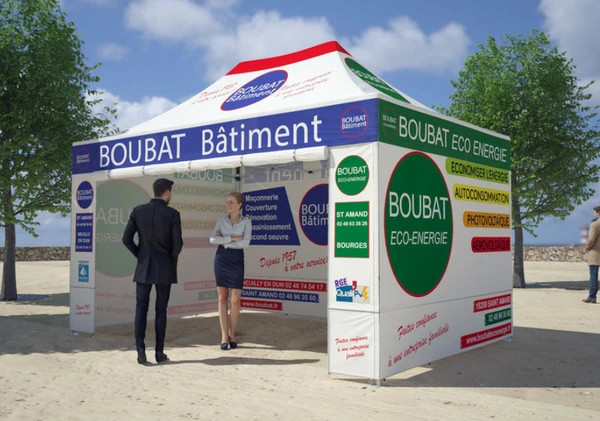
A backwall creates a large vertical advertising surface behind a display table. Half-height walls define the lower part of a booth while keeping the upper area open.
Full walls provide greater enclosure and additional space for campaign artwork.
For example, a company exhibiting at an outdoor product launch may prefer a printed backwall and two half walls instead of an entirely open canopy.
Choose this style when: Your booth needs a backdrop, controlled visitor approach or additional printed branding.
Check before ordering: Wall drop, attachment system, frame compatibility, access and ventilation.
Heavy Duty Commercial Canopies: For Repeated Business Use
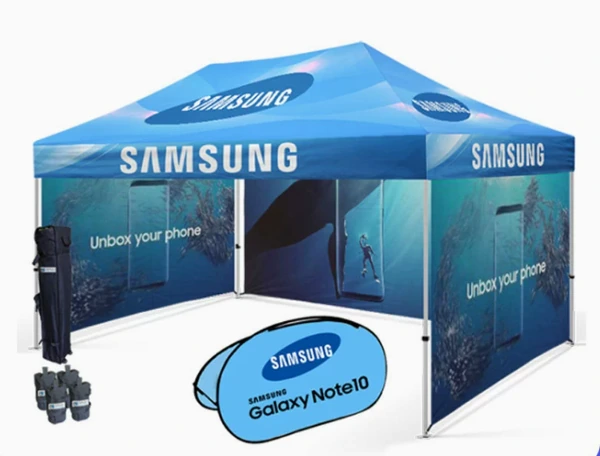
Commercial-focused folding canopies may use reinforced frames, larger structural profiles, substantial trusses and more robust connection systems.
However, “heavy duty” is a marketing description rather than a single universal structural classification.
Two canopies advertised as heavy duty can have different materials, tube wall thicknesses, joint designs and operating limits.
Choose this style when: Your business expects repeated setup, transportation and ongoing event use.
Check before ordering: Frame profile, tube thickness, total weight, truss construction, replacement components and verified performance documentation.
Food Vendor & Market Tents: For Selling and Service Layouts
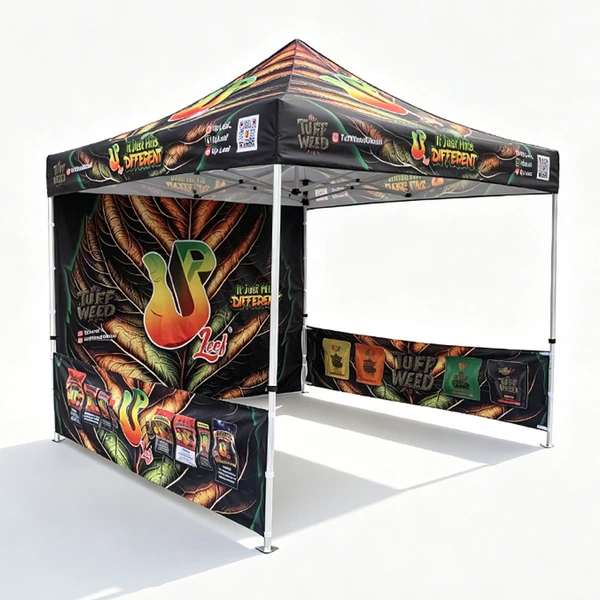
Food vendor canopies should be selected around the actual business operation: product display, customer ordering, staff movement, storage and serving.
A half-wall configuration can suit an open market counter, while certain food service operations may require different wall, access or protection arrangements.
Some specialized designs use serving windows or mesh panels, but availability and compatibility must be verified for the project.
Choose this style when: You operate a market stall, beverage promotion, bakery booth or food festival display.
Check before ordering: Venue approval, hygiene needs, cooking restrictions, ventilation and applicable fire requirements.
Inflatable Advertising Tents: For High-Visibility Activations
Inflatable event tents use air-supported structural components rather than conventional folding metal frames.
Four-leg spider-style inflatable tents create curved entrances and prominent surfaces for sponsor logos and event advertising.
Some systems use sealed air, while others require a continuously operating electric blower.
Choose this style when: The event benefits from a distinctive promotional structure, such as a sports sponsorship or brand activation.
Check before ordering: Inflation method, electrical supply, packed dimensions, sidewall options, usable space and anchoring.
Star Shade Tents: For Large Open-Air Event Displays
Star shade tents use one or more elevated poles and tensioned fabric extending toward multiple anchoring positions.
The result is a high-peak canopy with distinctive curved openings. Single-peak and multi-peak configurations can serve different event layouts.
Unlike an inflatable tent, a conventional pole-supported star tent does not require an air blower.
Choose this style when: Your event calls for a distinctive open-air promotional focal point or festival shelter.
Check before ordering: Overall span, center-pole location, opening height, actual usable coverage and anchoring footprint.
2. Choose the Correct Canopy Tent Size

One of the most common sourcing mistakes is selecting a tent only by its nominal width without checking actual space and equipment requirements.
Lovecolour’s illustrated folding canopy product range includes the following metric size configurations:
| Metric Size | Approx. Feet | Nominal Area | Potential Application |
|---|---|---|---|
| 2 × 2m | 6.6 × 6.6ft | 4m² | Compact sampling or reception point |
| 2.5 × 2.5m | 8.2 × 8.2ft | 6.25m² | Small branded display |
| 3 × 3m | 9.8 × 9.8ft | 9m² | Standard market or promotional booth |
| 2 × 3m | 6.6 × 9.8ft | 6m² | Rectangular vendor layout |
| 3 × 4.5m | 9.8 × 14.8ft | 13.5m² | Extended exhibition booth |
| 3 × 6m | 9.8 × 19.7ft | 18m² | Larger event or promotional area |
10×10 vs. 10×15 vs. 10×20: What Is the Difference?
In the US market, 10x10ft, 10x15ft and 10x20ft are common commercial canopy size descriptions.
These nominal dimensions correspond approximately to 3.05×3.05m, 3.05×4.57m and 3.05×6.10m.
A nominal 3×3m canopy is therefore close to, but not exactly the same as, a 10×10ft canopy.
The distinction matters when an event organizer specifies an exact booth size, or when replacement walls and roofs must fit an existing frame.
Do Not Confuse Footprint with Usable Area
The nominal ground area is not necessarily the complete usable space. Frame legs, display counters, equipment, storage and visitor circulation reduce the practical working area.
A 3×6m rectangular canopy has 18m² of nominal footprint, but the appropriate number of people or display stations cannot be calculated from that figure alone.
Special Shapes Need Different Measurements
Inflatable spider tents and star shade tents cannot always be compared using a conventional square footprint.
Curved openings, sloping fabric edges and support positions affect the actual usable area.
Request dimensioned drawings showing entrances, peak height, clearances and anchoring positions before booking the event space.
3. Compare Steel and Aluminum Canopy Frames
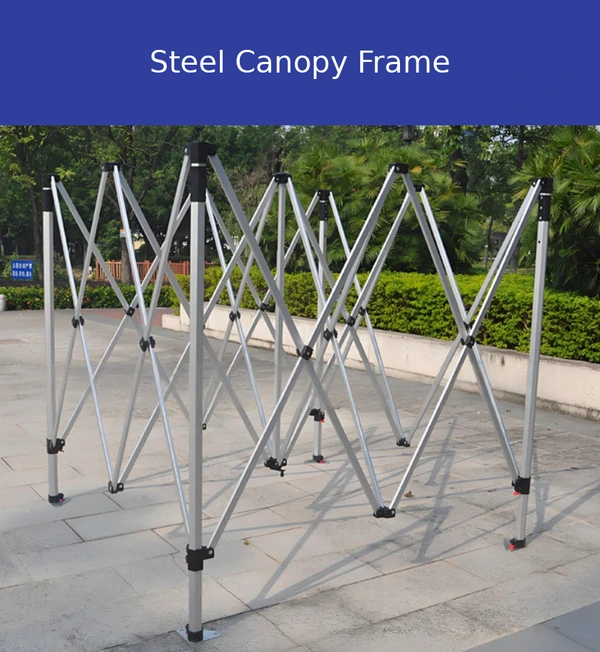
Frame selection affects purchasing cost, transportation, handling, maintenance and suitability for the intended use.
Steel Frames
Steel folding frames can be suitable where their construction, weight and price match the project.
Buyers should check tube thickness, protective coatings, joints, folding mechanisms and complete packed weight.
Aluminum Alloy Frames
Aluminum alloy frames may provide useful portability benefits, depending on the frame design.
Professional canopy systems can use square or hexagonal structural profiles. Some overseas commercial ranges include nominal 40mm and 50mm hexagonal-leg options.
These numbers describe profile dimensions, not a universal strength rating.
Why Frame Thickness Matters
Frame profile size and tube wall thickness are different specifications. A wider tube is not automatically proof of greater complete-frame strength.
Joint construction, truss layout, material grade, bracing and overall engineering also affect structural behavior.
For commercial orders, request comparable technical specifications for each frame under consideration.
Practical recommendation: For repeated use, compare the full frame specification and available replacement components, rather than relying on “heavy duty” in the product name.
4. Plan Your Custom Canopy Logo Printing
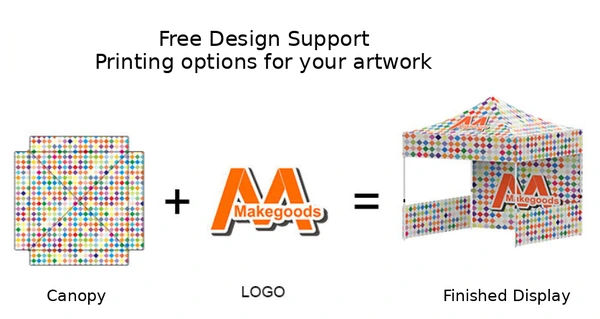
Custom branding should be planned around the way visitors will see the installed canopy.
A large logo on a roof panel may be visible from a distance, while a business name on the front valance is often easier to read at booth level.
Where Can You Print a Logo?
| Printing Area | Recommended Content | Main Consideration |
|---|---|---|
| Roof Panels | Large logo, brand graphics, sponsor artwork | Sloping orientation and seams |
| Valances | Business name, logo, short message | Readability and available height |
| Full Backwall | Campaign images, product photography, sponsor branding | Visibility around tables and equipment |
| Half Sidewalls | Horizontal logos and simple promotional messages | Support bars and attachment fittings |
| Inflatable Arches | Suitable curved-surface logos | Actual printable template and orientation |
| Star Tent Panels | Large artwork on sloping fabric | Panel direction and fabric tension |
Simple Logo vs. Full-Color Printing
A solid-color canopy with selected logo positions can be suitable for straightforward corporate branding.
Full-color printed designs are useful for colorful campaigns, promotional illustrations and coordinated event graphics.
Heat-transfer and digital printing are available for suitable fabric and production configurations.
The correct process depends on material, printing coverage, color requirements and artwork.
Prepare Artwork for the Actual Tent Template
The flat printing layout and the assembled tent are not the same.
For a peaked canopy, panels meet at the roof center. Logos must be oriented correctly on the individual panels before cutting and sewing.
Keep important text clear of seams, folds and fabric attachment points.
For a continuous design crossing different panels, discuss seam alignment and construction tolerances before artwork approval.
Vector logos in AI, EPS or print-ready PDF format are preferred. Provide Pantone references for important brand colors.
A production mockup should show the completed tent from the intended viewing directions.
5. Choose Suitable Canopy Fabric
Fabric specifications affect printing appearance, packing weight and outdoor performance.
The illustrated Lovecolour folding canopy range includes Oxford fabric options.
Different canopy products may use different polyester, coated or specialized fabric constructions. Inflatable products may also have separate air-retaining components.
What Should You Ask About Fabric?
- Material composition and construction
- Denier and fabric weight, where applicable
- Coating and seam construction
- Compatibility with the chosen printing method
- Water-resistance requirements
- UV-performance requirements
- Flame-performance documentation where required
- Cleaning and maintenance instructions
A higher denier value alone does not prove that a fabric has better performance in every condition.
Likewise, terms such as waterproof, UV-resistant and flame-retardant should be supported by applicable specifications or verified test documents.
6. Understand Wind, Anchoring and Venue Requirements
No portable event tent should be assumed suitable for all wind and weather conditions.
Proper anchoring is essential for outdoor installation, including commercial and heavy duty models.
Grass, Concrete and Sand
Different ground surfaces may require different manufacturer-approved securing arrangements.
Ordinary ground stakes, weights or sandbags should not be assumed suitable for every tent and location.
Why Sidewalls Change Wind Exposure
Installing full-height walls can change how wind forces act on the complete canopy.
Operating limits for an open canopy should not automatically be applied to a fully walled version.
Food Vendor Regulations
Food-related operations may be subject to additional health, ventilation and fire safety requirements.
For example, the New York City Health Department’s temporary food vendor checklist addresses food protection, equipment, documents and booth setup requirements for its jurisdiction.
This is a location-specific regulatory example, not a universal rule for all countries or events.
Buyers should confirm permit requirements, cooking restrictions, approved fabric performance, anchoring and installation rules with their venue or local authority.
7. Compare the Total Cost, Not Just the Tent Price
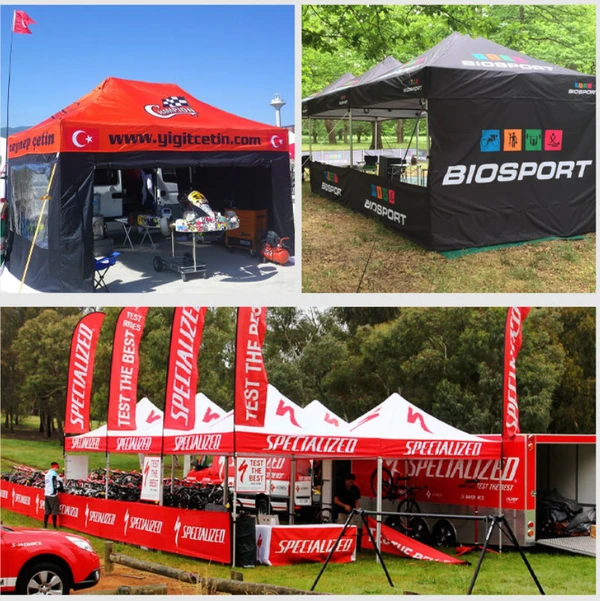
A custom canopy quotation should identify exactly which components and services are included.
A low headline price may exclude printed walls, transport accessories, anchoring equipment or international freight.
Factors That Affect Wholesale Pricing
- Canopy type and dimensions
- Frame material and structural specifications
- Fabric grade and coating
- Logo printing coverage and artwork variations
- Number and type of sidewalls
- Inflation equipment for inflatable models
- Specialized anchoring and installation accessories
- Order quantity and packaging requirements
- Packed dimensions and international freight
Think About Cost per Event
For a business using the same canopy repeatedly, consider the expected number of events, maintenance, handling and replacement needs.
A commercial-focused frame with an appropriate specification may be worth evaluating alongside a lower-cost model, but the choice should be supported by actual data.
No universal price advantage or service-life estimate applies to every design.
Understand EXW and Shipping Costs
Overseas buyers should confirm the applicable Incoterms, shipping destination and complete packing details.
Large frames and structural poles can create significant freight costs because of package dimensions and weight.
Ask for carton sizes, gross weights and the complete shipping terms before comparing offers.
8. How to Evaluate a Custom Canopy Tent Supplier in China
Buying custom canopy tents from China involves more than finding a low unit price.
Professional buyers should assess whether the supplier can define the product accurately and coordinate artwork, production, quality checks and shipment.
Confirm the Supplier’s Role
Some businesses manufacture particular products directly, while others coordinate additional categories through specialized suppliers.
Ask which items are produced directly and which are sourced through external partners.
For multi-product event campaigns, coordinated sourcing can be useful when the supplier clearly manages specifications, responsibilities and delivery.
Review Technical Documents
Request the actual frame specifications, material details and relevant performance documents for the model quoted.
Avoid accepting a generic certification claim without checking which material or product the document covers.
Check Artwork Approval
Confirm how printed layouts will be reviewed before production starts.
For complex logos, strict brand colors or unfamiliar construction, sample approval may be especially important.
Evaluate the Complete Supply Process
Guangzhou-based Lovecolour’s project approach describes a structured process from requirements and quotations through sampling, production and delivery.
Buyers can also review our customization and sourcing services to understand how artwork, sampling, supplier coordination and shipment planning are handled.
9. Choose Your Event Tent by Application
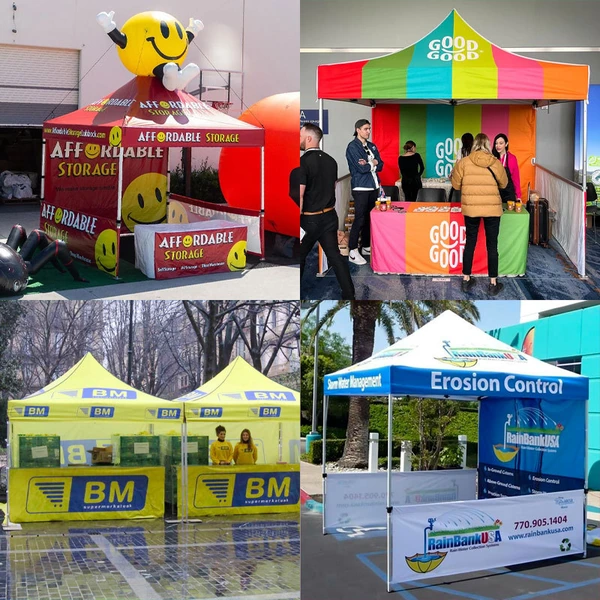
Trade Shows and Corporate Exhibitions
Start with a branded folding canopy if you need a conventional display booth.
Add a printed backwall when product photography, sponsor graphics or reception branding needs more space.
For a coordinated campaign involving tents, lanyards, badges and promotional gifts, see our trade show and conference merchandise solutions .
Sports Events and Brand Sponsorships
Compare folding commercial canopies and inflatable spider-style tents according to the required footprint, branding and event installation.
Inflatable structures may suit campaigns where the unusual shape is part of the promotional presentation.
Farmers Markets and Food Festivals
Choose the tent around product displays, service arrangements, customer access and local food service rules.
A printed half-wall or backwall can help organize a market stall, but special food preparation requirements must be evaluated separately.
Festivals and Large Outdoor Promotions
Star shade tents can provide a distinctive open-air promotional structure.
Confirm usable covered space, pole location and anchoring requirements before ordering.
Multi-Product Promotional Campaigns
A branded canopy often works best as part of a coordinated event merchandise package.
Matching printed tablecloths, event flags, staff lanyards, branded gifts and display accessories can create a consistent identity.
If your project includes promotional merchandise, explore our event giveaways and branded merchandise solutions .
10. What to Include in a Wholesale Canopy Tent RFQ
A detailed request for quotation helps suppliers compare the same specification and reduces the risk of incomplete offers.
| Information | What to Provide |
|---|---|
| Application | Event type, frequency of use and project background |
| Product Type | Pop up, commercial, inflatable, star or vendor tent |
| Size | Exact required dimensions and site limitations |
| Quantity | Total units and number of different designs |
| Structure | Frame preferences or required technical specifications |
| Fabric | Material, coating and performance requirements |
| Branding | Logo files, colors, print coverage and artwork positions |
| Accessories | Walls, bags, flags, pumps or other required components |
| Compliance | Venue, fire, structural and electrical requirements |
| Shipping | Delivery country, required date and preferred terms |
If some specifications are not yet decided, share your event type, available site space and approximate quantity.
The right supplier should help clarify the missing technical details before issuing a final quotation.
11. Common Custom Canopy Purchasing Mistakes
- Comparing different packages as if they were identical.
Check whether each quote includes the same frame, fabric, printing and accessories. - Assuming 3×3m and 10×10ft are identical.
Confirm actual dimensions for event spaces and replacement components. - Choosing a frame only by leg diameter.
Review tube thickness, material, trusses and joints. - Ignoring sidewall compatibility.
Wall lengths, heights and fasteners vary between frame systems. - Approving graphics from a flat layout alone.
Check the assembled tent mockup and logo orientation. - Assuming every tent is waterproof, windproof or flame-retardant. Request model-specific documentation for the performance you need.
- Forgetting shipping dimensions.
Long frame packages may affect transport cost and delivery planning. - Leaving venue compliance until installation day.
Check required permits, anchoring and technical documents before purchase.
Frequently Asked Questions About Custom Canopy Tents
What is the best custom canopy tent for a business event?
A conventional branded pop up canopy is a practical starting point for many temporary business events. Select the exact frame and size according to usage, site conditions and required branding.
What is the difference between a pop up canopy and a heavy duty commercial canopy?
Both can use folding frame structures. Heavy duty models may feature reinforced components and different technical specifications. Performance should be compared using model-specific data.
What size canopy is suitable for a trade show booth?
A nominal 3×3m or 10×10ft canopy is commonly considered for a compact booth. Always check the actual space allowed by the organizer and the required working layout.
Should I choose steel or aluminum for my canopy frame?
Compare total weight, structural specifications, transport needs, price and intended usage. Neither material automatically guarantees better complete-frame performance.
Can the whole canopy be printed with my logo and graphics?
Full-color printed designs can be reviewed for suitable fabrics and configurations. The final layout depends on panel construction, printing method and artwork.
Can I order a canopy with removable sidewalls?
Compatible full and half-wall arrangements are available in many folding canopy systems. Confirm the frame model, fittings and finished panel measurements.
Do inflatable event tents need electricity?
Constant-air designs normally need a continuously operating blower, while sealed-air designs generally do not need continuous electricity after inflation.
Is a star shade tent the same as an inflatable spider tent?
No. A conventional star shade tent relies on support poles and tensioned fabric, while an inflatable spider tent uses air-supported structures.
Can food vendors cook under a custom pop up tent?
Not automatically. Cooking permission depends on local regulations, equipment, venue rules, fabric performance and safety requirements.
What is the MOQ for custom canopy tents?
MOQ varies with the structure, size, artwork, material and production arrangements. Request confirmation for the selected model.
How much does a custom printed canopy tent cost?
Pricing depends on frame specifications, fabric, size, printing coverage, accessories, quantity and freight. Comparable quotations require a clear shared specification.
Can I order tents with different logos in one wholesale project?
Multiple artwork designs can be reviewed as part of one project. Individual quantities, setup requirements and pricing should be confirmed for each design.
Final Buying Checklist: Choose the Tent That Fits the Project
There is no single best custom canopy tent for every event.
A folding pop up canopy may be the most practical option for a standard booth. A reinforced frame may be worth evaluating for repeated commercial use.
Printed walls provide additional branded surfaces, while inflatable and star shade structures offer distinctly different visual and installation options.
Before purchasing, confirm five essentials: the actual structure, usable dimensions, material and branding, installation conditions, and complete delivered cost.
A well-specified tent is easier to quote accurately, approve for production and coordinate for an event.
Custom Event Tent & Promotional Merchandise Sourcing from China
Guangzhou-based Lovecolour helps international B2B buyers source customized promotional products and coordinated branded merchandise.
We work with project requirements covering artwork, specifications, sampling where needed, production coordination and delivery arrangements.
For businesses seeking wholesale custom canopy tent solutions from China, our team can review the required structure, quantity, branding and intended event use.
Promotional product distributors in the United States, exhibition agencies in Europe, corporate buyers in Australia and event organizers in the Middle East can submit their project details for a suitable sourcing review.
Not every promotional product is manufactured in the same facility. The supply arrangement depends on the category, with specifications and delivery coordinated according to the project.
Explore more B2B promotional merchandise buying guides , or review Lovecolour’s custom sourcing and production services .
Planning a Custom Event Tent Project?
Send us your tent type, target dimensions, quantity, logo artwork, event date and destination country.
If you are still comparing options, share your event requirements and intended budget range. We can review suitable alternatives before preparing a detailed quotation.
Lovecolour – Global B2B Promotional Products & Branded Merchandise Partner
Explore branded event merchandise solutions or contact our team through the website’s inquiry channel to discuss your project.