A custom printed canopy tent is more than a shelter with a logo. It is a large-format advertising display that represents your brand at trade shows, outdoor promotions, sports events, farmers markets and corporate activities.
A successful canopy design needs more than attractive graphics. Buyers must consider where the logo will be visible, which fabric and printing method to use, how the flat artwork fits the sewn panels, and how colors and measurements will be confirmed before production.
This guide explains how to prepare artwork for a custom canopy tent, compare logo printing options, choose suitable branding positions and avoid common mistakes when ordering printed event tents in bulk.
It is designed for promotional products distributors, event organizers, marketing agencies, apparel brands, corporate procurement teams and international wholesale buyers.
Quick Answer: What Is the Best Way to Print a Logo on a Canopy Tent?
For a business that wants a clear, recognizable event booth, place its main logo or business name on the front valance and use the sloping canopy panels for larger branding elements.
If the booth needs additional advertising space, add a printed backwall or compatible sidewalls. For colorful artwork, suitable full-color printing methods can be used, depending on the fabric, design and production specifications.
Always prepare the artwork using the exact template for the selected canopy model. Check logo orientation, sewing allowances, safe areas and the completed 3D appearance before approving production.
| Branding Requirement | Recommended Area | Key Consideration |
|---|---|---|
| Visible company name | Front valance | Readable text and strong contrast |
| Large company logo | Sloping roof panels | Viewing angle and panel orientation |
| Product photography | Full printed backwall | Image quality and viewing distance |
| Additional sponsor branding | Side valances and walls | Consistent layout across panels |
| Complete brand experience | Roof, walls and matching displays | Coordinated artwork and colors |
1. Where Can You Print a Logo on a Custom Canopy Tent?
The available branding surfaces depend on the selected canopy size, roof construction and optional wall configuration.
A conventional peaked pop up canopy usually has multiple sloping roof panels and horizontal valances around the lower edge of the roof.
Printed backwalls and sidewalls can provide additional vertical advertising surfaces.
Canopy Roof Panels: For Large Brand Graphics
Sloping roof panels are suitable for large logos, brand colors, sponsor graphics and promotional patterns.
These panels are visible from different angles, especially when visitors approach the event from a distance.
However, not every part of the roof is equally visible from ground level. A logo positioned too high or too close to the peak may be harder to read from certain viewing directions.
For a conventional four-sided peak roof, each face can carry the same logo or different approved artwork.
When multiple logos are required, identify the intended viewing direction for each face before preparing the print-ready design.
Front Valance: For Readable Business Names
The valance is the horizontal fabric section hanging below the sloping canopy roof.
It is often one of the most useful branding positions because customers standing in front of the booth can see it directly.
Good valance content includes:
- A company name or recognizable brand logo
- A short promotional message
- A product or service category
- A concise website address when useful
Avoid filling the valance with long sentences, multiple small logos or difficult-to-read text.
The available printed height varies by canopy model. Always use the actual valance dimensions provided in the production template.
Side and Rear Valances: For Multi-Direction Visibility
At an outdoor festival or market, customers may approach the booth from several directions.
Printing the business name or logo on additional valances can make the booth easier to recognize.
For event organizers managing multiple vendors, different sides can carry different approved messages or sponsor artwork.
A consistent logo size and color scheme often creates a more professional appearance than placing unrelated graphics on every panel.
Full Backwall Printing: For High-Impact Displays
A printed full-height backwall provides a large vertical advertising surface behind the booth’s reception area or product display.
It can feature product photographs, campaign graphics, sponsor logos, service descriptions or a large central company logo.
When designing a backwall, consider where tables, chairs and equipment will be placed.
Important text should not be hidden behind furniture after installation.
Half Sidewall Printing: For Counter-Style Booths
Half-height sidewalls provide additional lower-level branding without fully enclosing the booth.
They are suitable for farmers markets, product sampling, food promotions and portable event reception counters.
A simple logo, repeating brand pattern or short message often works better than a complicated graphic.
The final printing layout must account for the compatible support bars, hem allowances and attachment fittings.
Full Sidewalls: For Coordinated Brand Environments
Full-height sidewalls can extend a brand design across several surfaces of the booth.
For example, a custom canopy can combine a branded roof with a printed rear panel and two full-height sides.
The graphics may use a continuous visual theme even when individual panels have different dimensions.
Avoid assuming artwork will align perfectly across detachable wall junctions without checking seams, fittings and installation tolerances.
2. Four Popular Custom Printed Canopy Configurations
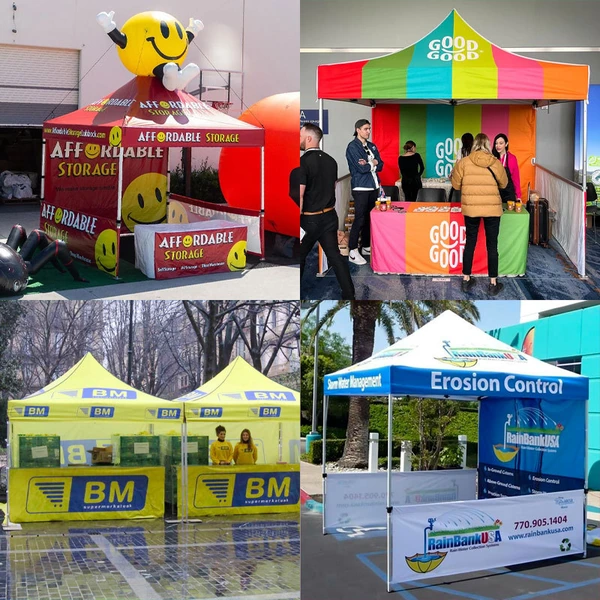
Buyers do not always need to print every available surface. A suitable configuration depends on event requirements, branding objectives and budget.
| Configuration | Printed Surfaces | Typical Applications |
|---|---|---|
| Canopy Only | Roof panels and valances | General outdoor promotions and events |
| Canopy + Backwall | Roof, valances and one full wall | Exhibitions and product demonstrations |
| Canopy + Backwall + Half Walls | Roof, rear wall and lower side panels | Markets, branded counters and sampling |
| Canopy + Three Full Walls | Roof and three large wall surfaces | Defined promotional booths and displays |
The canopy and sidewalls can be coordinated with the same brand colors and design language.
However, wall fittings, layout and material suitability must be confirmed for the selected folding frame.
Buying recommendation: Start with the surfaces that customers will actually see. A well-positioned logo on the front valance and canopy roof may meet the requirements of a simple promotional booth.
For trade shows and product launches, a printed backwall may provide greater marketing value than adding excessive detail to the roof.
3. Canopy Tent Printing Methods: Which Is Right for Your Design?

The best printing process depends on material composition, artwork, required coverage, order quantity and production equipment.
The terms heat-transfer printing, dye-sublimation and digital printing are sometimes used loosely in promotional product listings, but they do not always describe identical processes.
Heat-Transfer Printing
Heat-transfer printing uses heat and pressure to transfer a design onto a suitable material.
Depending on the process, a transfer may involve printed inks, transfer films or other specialized materials.
This method can be evaluated for selected logos and full-color designs on compatible canopy fabrics.
Its suitability depends on the fabric, coating, equipment and required print durability.
Dye-Sublimation Printing
Dye-sublimation is commonly used for full-color graphics on compatible polyester fabrics.
During sublimation, dyes are transferred and incorporated into suitable synthetic fibers under controlled processing conditions.
It can reproduce large colorful patterns, photographic elements and detailed promotional graphics.
However, not every Oxford fabric or coated textile is suitable for the same sublimation process.
Material compatibility must be confirmed before production.
Digital Printing
Digital printing is a broad category that includes several printing technologies.
It is commonly considered for complex artwork, gradients, multicolor graphics and customized advertising surfaces.
The printing process should be selected according to fabric chemistry, coatings, color expectations and finished product requirements.
Screen Printing or Simple Logo Printing
For simple logos, suitable spot-color printing processes may also be considered depending on the product, fabric and supplier equipment.
Buyers should not assume screen printing is available for every coated canopy fabric.
Confirm feasibility, color limitations and setup requirements.
| Printing Approach | Potential Use | Important Check |
|---|---|---|
| Heat Transfer | Selected logos or graphics | Transfer chemistry and fabric compatibility |
| Dye Sublimation | Full-color polyester fabric graphics | Polyester composition and coatings |
| Digital Printing | Complex and multicolor artwork | Specific ink and textile process |
| Spot-Color Printing | Suitable simpler artwork | Color count, setup and material suitability |
Important: No single printing method is automatically the best choice for every custom canopy tent. The final specification should be approved for the selected fabric.
4. How Does Canopy Fabric Affect Printing Quality?
Canopy fabric influences print appearance, texture, color reproduction, folding characteristics and performance.
The illustrated Lovecolour folding canopy range includes Oxford fabric options. Different fabric specifications may require different printing and finishing methods.
Oxford Fabric
Oxford describes a textile weave or fabric construction rather than a single universal material specification.
Oxford fabrics may have different fiber compositions, weights, coatings and intended applications.
Before printing, confirm the exact fabric grade rather than relying only on the term “Oxford fabric.”
Polyester Fabric
Polyester is widely used in printed promotional textiles and selected canopy applications.
Suitable polyester fabrics may support full-color dye-sublimation printing, subject to their construction and coating.
Coated Materials
Canopy fabrics may use surface coatings for particular protective or functional requirements.
Coatings can affect ink adhesion, transfer conditions and finished print appearance.
A fabric that works well with one printing method may be unsuitable for another.
Fabric Weight and Denier
Buyers may see terms such as 210D, 420D or 600D when comparing fabric products.
Denier refers to yarn linear mass, not the complete fabric weight or a guaranteed level of strength.
Fabric weight, weave, coating, fiber type and construction also matter.
Do not assume a higher denier number alone guarantees better print quality or greater service life.
Water Resistance and Flame Performance
For outdoor events, buyers may require specific water-resistance, UV or flame-performance characteristics.
These properties depend on the actual fabric and finished construction.
If a venue requires flame-performance documents or other test reports, provide the applicable standard before ordering.
Printing and finishing should be assessed together with the required material performance.
5. How to Prepare Print-Ready Canopy Tent Artwork
Artwork preparation is one of the most important steps in custom canopy manufacturing.
A canopy is made from fabric sections that are cut, printed and assembled according to the selected construction method.
An attractive flat graphic does not automatically translate into a correctly oriented completed tent.
Step 1: Confirm the Exact Tent Size and Frame
Before designing, identify the actual canopy model.
The nominal size alone does not always define the finished fabric dimensions.
Different frames can have different peak heights, roof angles, valance drops and attachment arrangements.
The production dieline should correspond to the actual approved model.
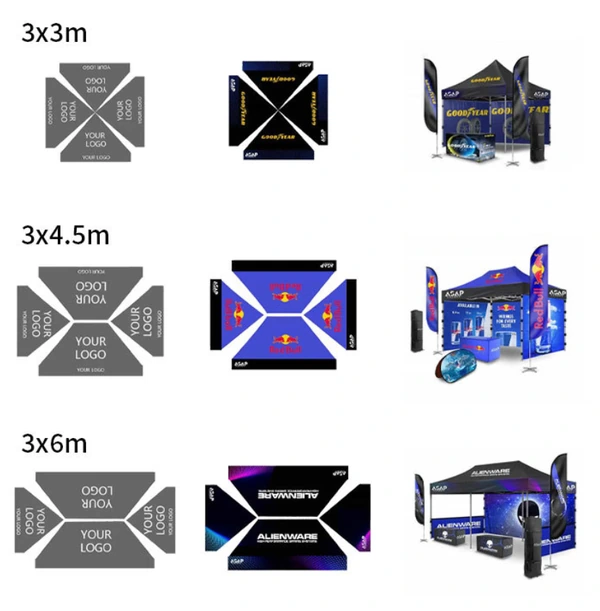
Step 2: Use the Correct Flat Artwork Template
A flat canopy artwork template shows the printable fabric sections before assembly.
For a typical square peaked canopy, it may include four sloping roof panels and four valances.
Rectangular canopies use different panel dimensions on their long and short sides.
Do not use a generic 3×3m template for a 3×4.5m or 3×6m canopy without checking the actual construction.
Step 3: Check Every Logo’s Orientation
One common design error occurs when logos are placed in the same direction on the flat template without considering the final roof assembly.
After the canopy panels are joined, each printed logo should face the intended viewing direction.
For example, a company may want its logo readable on all four sides of a square canopy.
The individual design must be oriented correctly for each panel, not simply repeated without rotation.
Step 4: Allow for Bleed, Seams and Safe Areas
A printing template normally identifies areas for trimming, sewing and important artwork placement.
Background colors or patterns may need to extend beyond the finished visible edge according to the supplier’s bleed requirements.
Important logos, contact information and small text should remain within the approved safe area.
Do not invent a universal bleed measurement for all custom tent models.
Use the actual dimensions provided in the production template.
Step 5: Understand Continuous and Panel-Specific Artwork
Some printed canopy designs use repeating patterns that continue visually across multiple areas.
Other designs use precisely positioned logos, stripes or illustrations that must meet at specific panel junctions.
These two approaches need different artwork checks.
For an all-over pattern, the overall visual effect may remain acceptable without exact alignment of every individual motif at a seam.
For registered graphics, where lines, letters or shapes are intended to connect across a seam, alignment and sewing tolerances must be discussed before production.
A repeating design is not automatically seamless, and a continuous illustration is not automatically guaranteed to align perfectly after sewing.
Step 6: Prepare the Correct Artwork Files
Vector artwork is generally preferred for company logos because it can be scaled without losing sharpness.
Common formats include:
- AI – Adobe Illustrator artwork
- EPS – Vector artwork format
- PDF – Print-ready vector or layout file
- High-resolution TIFF, PNG or JPEG for suitable raster graphics
For raster images, the required resolution depends on the final print size, viewing distance and printing system.
Do not assume a small website logo or low-resolution screenshot is suitable for printing across a large canopy panel.
Ask the printer for the required resolution at the actual production scale.
Step 7: Confirm Fonts and Text
Where required, convert fonts to outlines or provide the necessary approved font information.
Carefully proofread:
- Company and brand names
- Website addresses
- Telephone numbers
- Product names and slogans
- Sponsor logos and partner names
- Event dates and location information
Check the spelling on every printed panel, especially when artwork contains multiple languages.
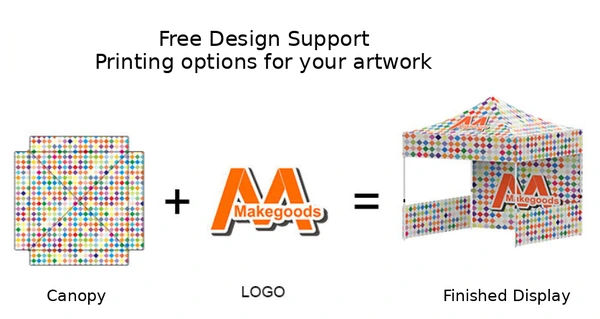
Step 8: Review the Assembled 3D Mockup
The final approval should consider both the flat production layout and the assembled appearance.
A rendered tent mockup helps buyers verify logo size, overall balance and the visible relationship between roof, valances and walls.
However, a mockup does not replace technical checks of cutting lines, sewing allowances and print-ready files.
6. Artwork Planning for 3×3m, 3×4.5m and 3×6m Canopies
Different canopy dimensions require different branding arrangements.
The illustrated folding canopy range includes 2×2m, 2.5×2.5m, 3×3m, 2×3m, 3×4.5m and 3×6m models.
| Canopy Size | Nominal Layout | Recommended Design Focus |
|---|---|---|
| 2×2m | Compact square | Simple logo and short business name |
| 2.5×2.5m | Small square | Clear front branding and restrained graphics |
| 3×3m | Standard square | Roof logo, valances and optional backwall |
| 2×3m | Narrow rectangle | Design for differing short and long sides |
| 3×4.5m | Extended rectangle | Long-side branding and panel orientation |
| 3×6m | Large rectangle | Large graphic hierarchy and wide backwall planning |
3×3m Canopy: Balanced Four-Side Branding
For a standard 3×3m promotional canopy, the main brand can appear on the sloping roof faces and front valance.
If customers approach from every direction, consider using the same recognizable identity around the canopy.
3×4.5m Canopy: Longer Promotional Messages
A rectangular canopy provides different visible proportions on the long and short sides.
Use the longer valances for appropriate brand messages, while keeping short-side graphics simple and readable.
3×6m Canopy: Organize Larger Graphics
A larger rectangular canopy creates more advertising space, but overly complicated designs can still be difficult to read.
Define a clear visual hierarchy between the main logo, supporting graphics and promotional text.
Printed backwalls and compatible sidewalls can be used to extend the branding concept.
Important: These are design recommendations based on nominal sizes. The exact printable areas must be taken from the approved manufacturing templates.
7. Pantone, CMYK and Brand Color Matching
Accurate branding depends on more than selecting a color on a computer screen.
Canopy materials, inks, coatings, lighting conditions and printing equipment can all affect the finished appearance.
Why Screen Colors May Look Different in Print
A design viewed on a digital screen uses light-emitting display colors.
Printed fabric reflects ambient light, and the achievable color range depends on the printing process.
Certain bright or highly saturated screen colors may not reproduce identically on a chosen textile.
Using Pantone References
Providing Pantone references can help communicate target brand colors.
However, a Pantone reference does not automatically guarantee an exact match on every printed fabric.
A practical approach is to compare the target color with an achievable print sample on the actual selected material.
How to Improve Color Consistency
- Provide official brand color references.
- Confirm the actual canopy fabric before printing.
- Use an approved artwork file consistently.
- Review suitable printed samples when color accuracy is critical.
- Agree on realistic color tolerances before bulk production.
- Check color coordination across different promotional products.
For multi-product event campaigns, printed canopies, flags and tablecloths may use different materials and printing methods.
Perfect visual identity does not always mean identical measured colors on every surface.
The achievable consistency should be reviewed according to the selected materials and production methods.
8. Seven Common Custom Canopy Printing Mistakes
- Using the wrong production template.
A generic canopy drawing may not match the selected frame and roof construction. - Placing important logos too close to seams.
Stitching and folding allowances can affect the finished graphic. - Ignoring orientation on roof panels.
A logo can look correct on a flat file but face the wrong direction after assembly. - Using low-resolution artwork.
An image suitable for a website may become blurry at large print size. - Overloading the design with text.
Long messages and small type can reduce readability at busy events. - Assuming exact color matching.
Different fabrics and printing methods can produce visible variation. - Approving only a 3D rendering.
The visual mockup should be checked together with the correct production files.
A well-prepared print project reduces uncertainty before the fabric enters production.
9. What Affects the Cost of Custom Canopy Printing?
Custom canopy printing costs vary according to the design and production specification.
The largest printed area is not always the best use of a promotional budget.
Printing Coverage
A small logo on a solid-color canopy may have different manufacturing requirements from an all-over full-color roof.
Fabric Selection
Different fabric grades and coatings can influence both printing feasibility and unit cost.
Artwork Complexity
A straightforward company logo is generally easier to prepare than complex multi-panel graphics requiring precise alignment.
Number of Printed Panels
Printed roof faces, valances, full walls and half walls each affect the complete project configuration.
Order Quantity and Number of Designs
A bulk order using one approved design may have different production costs from an order with many individual artwork variations.
Sampling and Artwork Approval
Projects requiring physical samples, special color checks or additional technical review may have different timelines and costs.
Wholesale buying tip: Compare suppliers using the same canopy size, fabric, printing coverage, accessories and order quantity.
Ask whether the quotation includes the printed fabric cover, frame, backwalls, sidewalls, artwork preparation and packaging.
10. Wholesale Custom Printed Canopy Tents from China

For international promotional products distributors and event organizers, the main procurement challenge is not simply finding a supplier who can print a logo.
It is confirming that the selected frame, fabric, artwork and production specifications work together.
When comparing custom printed canopy suppliers in China, ask about the full workflow from artwork review to completed shipment.
What Should a Supplier Confirm?
- Actual canopy dimensions and frame model
- Fabric composition, grade and coating
- Suitable printing technology
- Logo placement and approved artwork templates
- Number of different designs
- Sample and color confirmation requirements
- Production quantity and schedule
- Included frame and wall components
- Packing dimensions, shipping weight and trade terms
For US and European Buyers
Check whether the selected metric canopy size matches the event organizer’s required footprint.
If the venue requires specific flame-performance documentation, provide the exact applicable standard before ordering.
For Australian and Middle Eastern Buyers
Consider the intended outdoor environment, site restrictions, event duration and required material performance.
Do not assume that a generic printed canopy is suitable for every climate or weather condition.
Guangzhou-Based Event Merchandise Sourcing
Lovecolour is a Guangzhou-based promotional products and branded merchandise supplier serving international B2B buyers.
We support project requirements covering custom artwork, material selection, sampling arrangements and coordinated promotional merchandise sourcing.
For custom canopy projects, buyers can provide their artwork, target dimensions and order quantity for specification review and quotation.
For broader events, related printed table covers, advertising flags, staff accessories and promotional gifts can be considered as part of a coordinated project.
Explore Lovecolour’s custom promotional products for additional branded merchandise sourcing solutions.
11. Custom Canopy Printing RFQ Checklist
To receive a more accurate quotation, send the following details to your custom canopy supplier.
| Information | What to Provide |
|---|---|
| Canopy Type | Standard folding, commercial-grade or other model |
| Size | Exact metric or imperial dimensions |
| Frame | Steel or aluminum; preferred model if known |
| Fabric | Required material and performance specifications |
| Printing | Roof, valances, backwalls and sidewalls |
| Artwork | AI, EPS, PDF or suitable image files |
| Colors | Brand color references and print expectations |
| Quantity | Units per design and total quantity |
| Accessories | Walls, flags, table covers and transport items |
| Delivery | Destination, trade term and required date |
If your artwork is not yet finalized, a reference design and clear description can help the supplier understand your project.
The final quotation should be confirmed after specifications and print coverage have been agreed.
Frequently Asked Questions About Custom Canopy Tent Printing
Where is the best place to put a logo on a canopy tent?
The front valance is often useful for a readable business name, while the sloping roof panels provide space for larger logos and graphics. The best placement depends on viewing angles and the event layout.
Can I print different logos on each canopy side?
Yes, different artwork can be planned for individual panels, subject to the selected printing method and approved production templates.
Can a canopy tent be fully printed in color?
Full-color printing can be provided for suitable fabrics and production configurations. The exact technique depends on material and artwork.
What is the difference between heat transfer and dye sublimation?
Heat transfer is a broad term for using heat and pressure to transfer graphics. Dye sublimation is a specific process commonly used with compatible polyester materials.
What file format is best for a canopy logo?
Vector files such as AI, EPS and print-ready PDF are preferred because logos can be scaled without losing edge sharpness.
How much bleed should I add to canopy artwork?
Use the bleed specified in the actual production template. There is no universal measurement that applies to every tent model and printing system.
Will printed graphics align perfectly across sewn seams?
Alignment depends on the artwork, fabric construction, cutting accuracy, sewing and assembly tolerances.
Designs requiring registered seam alignment must be reviewed before production.
Can I match the exact Pantone color of my brand?
Pantone references can guide color matching, but the achievable result depends on material and printing technology. Physical color approval may be necessary for critical projects.
Can I print on waterproof or coated tent fabric?
Printing feasibility depends on the exact fabric and coating. The selected printing method must be compatible with the material.
Can I purchase a replacement printed canopy top?
Replacement canopy top requests can be evaluated when the exact frame model, measurements and attachment details are known.
Can I order a printed canopy with matching sidewalls?
Yes, compatible printed wall configurations can be reviewed together with the canopy design.
What affects wholesale canopy printing prices?
The price depends on size, fabric, printing process, coverage, artwork variations, quantity, accessories and production requirements.
What is the MOQ for custom printed canopy tents?
MOQ depends on the selected canopy model, fabric, artwork and order quantity. Request confirmation for the exact configuration.
How long does custom canopy printing take?
Production time depends on the approved artwork, fabric, configuration and quantity. A project-specific schedule should be confirmed before placing the order.
Final Recommendations: Design for Visibility, Print for Accuracy
Successful custom canopy tent printing starts with a clear branding objective and an accurate production template.
Choose logo positions based on how customers will see the booth, not simply how much fabric is available.
Select a suitable fabric and printing method, prepare accurate artwork, review the assembled design and approve critical colors before bulk production.
For wholesale orders, confirm the entire tent package, including frame, printed roof, walls, accessories and shipping requirements.
These steps help reduce artwork misunderstandings and support a more predictable custom production process.
Request a Quote for Custom Printed Canopy Tents
Need custom printed canopy tents for an exhibition, sports event, marketing campaign, farmers market or branded corporate event?
Lovecolour can review your artwork, desired canopy size, quantity, printing coverage and project requirements for a suitable customization solution.
Please send:
- Your preferred canopy size and quantity
- Company logo and design files
- Required printed panels and walls
- Fabric or frame preferences
- Destination country and event deadline
Lovecolour – Global B2B Promotional Products & Branded Merchandise Partner
Visit Lovecolour Promotional Products or use the website inquiry form to discuss your custom canopy project.